
Get in touch

Leave your details below and one of our specialists will be in touch as soon as possible.

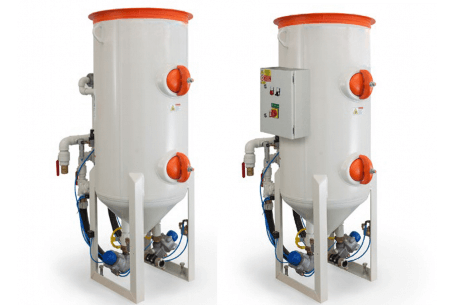
DS2000 double-layer continuous sandblasting pot

Controlled remotely by a switch on the blasting gun, this peening pot automatically refills during operational pauses. This ensures continuous workflow by virtually eliminating delays caused by media loading.

Features and benefits:
abrasive-blasting-pot45

Product Description:

The DS200M-EP abrasive blaster is a comprehensive pressure blasting system featuring an electro-pneumatic control box and a deadman’s handle for enhanced safety and operational control. The complete package includes a 200-litre pressure blast pot equipped with a pop-up valve, a pneumatic main air valve, and a pneumatic exhaust valve with silencer. For abrasive management, it comes with a manual abrasive valve. Operator control is facilitated through a pneumatic remote control system integrated with the deadman’s handle, connected via a 25-meter remote control hose and a 25-meter cable specific to the EP edition. Essential air preparation is handled by a built-in moisture separator. The system also provides 20 meters of heavy-duty 1¼” blast hose, a blast coupling, a nozzle holder, a high-performance tungsten venturi blast nozzle, and a built-in two-step helmet filter for operator protection.

Working Principle of the Abrasive Blasting Pot:

The abrasive blasting pot is filled with abrasive media. After pressure is established inside the pot, the abrasive media, driven by gas pressure and its own weight, enters the mixing chamber of the concentrated shot peening valve through the conical hopper at the bottom of the pot. The two-phase flow of shot and gas is then ejected through the output pipe and nozzle at a speed of approximately 60 meters per second.

Disa abrasive blasting pot: the components

disa-blasting-pot12
Blast tank

The main heavy-duty steel tank that holds the abrasive media under pressure (typically up to 125–150 psi). Includes conical bottom for gravity feed.

abrasive-blasting-sieve
abrasive blasting sieve

Use an abrasive blasting seive when filling Abrasive Blasting Pot with Abrasive to prevent debris from entering the Abrasive Blasting Pot .

pop-up valve

Located at the top fill opening. Automatically rises and seals the pot when pressurized; drops when depressurized to allow safe refilling. Includes a seating ring/gasket for airtight seal. Critical safety and operational part.

Safety Relief Valve

Automatically vents excess pressure if it exceeds the vessel’s rated limit.

Diaphraqm-Outlet-Valve
Automatic Exhaust Valve

Safely releases pressure from the pot when stopping blasting or for refilling (often paired with remote controls).

inlet-air-valve
Air Inlet Valve

Controls compressed air entry into the pot from the compressor.

abrasive-metering-valve
Abrasive Metering Valve

At the bottom outlet. Precisely controls how much abrasive enters the air stream. The most important valve for blast quality and media consumption. Some models are manual; others are automatic or remote-controlled.

inspection-door
inspection door

Side access panel (with gasket) for cleaning debris or inspecting inside the vessel.

muffler
muffler

Self-cleaning exhaust muffler greatly reduces bleed-off noise.

abrasive-blasting-pot91
Umbrella Assembly

Perforated screen over the fill opening to block large debris; optional lid or cam-lock cover.

blast-gun
T. C. Lined Long Venturi Nozzle

The long series convergent-divergent tungsten carbide lined blasting nozzle ensures high velocity, evenly distributed blast pattern & higher blasting output and provides lower wear, longer life and greater resistance against breakage.

blast-hose1
Blast Hose

The blast hose is highly abrasion resistance with longer life, high flexibility with lower bend radius and light weight and electrically antistatic for safe operation.

water&oil seperator
Moisture Separator

Removes water, oil, and contaminants from incoming compressed air. Essential to prevent clumping or blockages. Has a manual or automatic drain.

Pressure-Gauge
Pressure Gauge

Monitors internal vessel pressure in real time.

Remote-Control-System
Remote Control System

Pneumatic (or electric) valves and twinline control hose connected to the operator’s deadman handle. Instantly stops blasting if the operator releases the handle. Includes combination valves or automatic air valves.

Control box

The blast pot can be switched off quickly, which gives double safety.

Vibrator
Other Common Accessories

Exhaust muffler/silencer (quiets depressurization).
• Vibrator (optional, for difficult media).
• Gaskets, O-rings, seals, and wear parts (pop-up shaft, metering valve seats).
• Blast hose, nozzle holder, and nozzle (connected downstream).

abrasive-blasting-pot38

How a Typical Pressure Pot Works?

1.Fill the pot with dry abrasive through the top (pop-up valve is down).
2.Close the exhaust valve and open the air inlet → vessel pressurizes → pop-up valve seals automatically.
3.Adjust the metering valve for desired abrasive flow.
4.Operator squeezes the deadman handle → air + abrasive flows through the blast hose and nozzle.
5.Release the handle or close valves → depressurize → pop-up drops for refilling.
Two main operating styles exist:
Pressure Hold — Pot stays pressurized between blasts (faster restarts).
Pressure Release — Pot depressurizes each time (safer for some applications).
Safety & Maintenance Notes:
Never exceed the vessel’s rated pressure.
Always use a functioning deadman control and proper PPE (helmet with supplied-air breathing, blast suit, gloves).
Drain moisture separator daily and use dry air.
Regularly inspect/replace pop-up valve, metering valve seats, gaskets, and blast hose (wear is rapid).
Use an abrasive screen when filling to avoid contamination.
These components are consistent across major brands (Schmidt, Clemco, Marco, Norton, etc.), though valve designs and exact part numbers vary. Replacement parts (valves, pop-ups, seals) are widely available from blasting equipment suppliers.