
- View Products
- Blasting pots
- Blasting cabinets
- Suction blasting cabinets
- Pressure blasting cabinets
- Blasting machine with rotary basket
- Turntable blasting machine
- Throughput blasting machine
- Roller conveyor blasting machine
- Internal blasting machine
- Multi-nozzle blasting machine
- Satellite table machine
- Blasting installation with sliding door
- Robotic blasting machine
- Precision spotblaster
- Shot blasting room
- Shot blasting container
- Automated shot peening machines
- shot blasting equipment
- wheelblasting machines
- Spinner hanger
- Tumble belt shot blasting machine
- Rotary table blast machine
- Roller conveyor wheelblasting machine
- Overhead monorail conveyor shot blasting machine
- Turn table
- Bogie table work car shot blasting machine
- Continuous tumblast machine
- preservation line
- Stone and brick shot blasting machine
- Anchor chain shot blasting machine
- Steel pipe shot blasting machine
- Gas cylinder shot blasting machine
- Drum type wheelblasting machine
- Mobile concrete floor shot blasters
- Wire mesh conveyor wheelblasting machine
- gas cylinder shot blasting machine
- disa blasting wheels
- Blasting media
- wheelblasting machines
- Blasting media
- Dust collectors
- Blasting with compressed air
- References
- Blasting Knowledge
- Internal Pipe Shot Peening System
- Gas cylinder inside blasting machine
Need advice?
Need advice? Call or WhatsApp us, and you’ll get a reply within 5 minutes!
- (86)-0532-012345678
- 15112345678
- disa@disachina.com
Get in touch
Leave your details below and one of our specialists will be in touch as soon as possible.
Spinner hanger wheel blasting machine
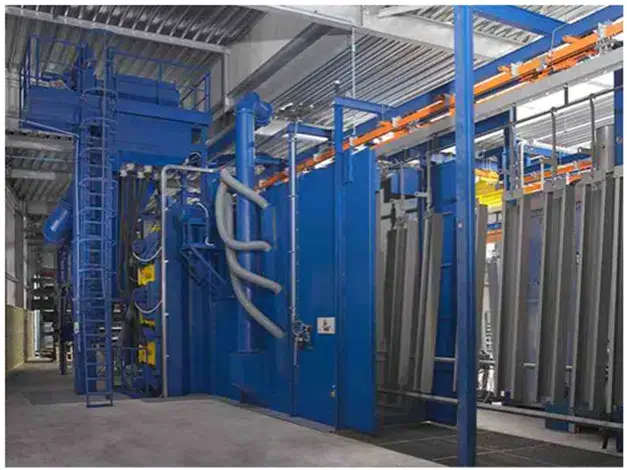
The spinner hanger shot blast machines from disa deliver unmatched flexibility for your blasting operations. Whether you’re cleaning welded structures and fabrications, deburring and finishing castings, or shot peening components subjected to dynamic stress, these systems support an exceptionally wide range of applications—making them a versatile solution for virtually any surface preparation challenge.
The combination of rotation and oscillation inside the blast chamber can be cleaned throughly—even for the most complex and demanding workpieces. Powered by DISA high performance blast wheel, our spinner hanger shot blast machines deliver unmatched productivity and efficiency. The Disa blast wheel significantly enhances blasting intensity while offering exceptional wear resistance. Available in both single-cycle and continuous-operation configurations, with a wide range of capacities and models, Disa overhead rail shot blast machines strike an outstanding balance between performance, versatility, and cost-effectiveness.
Read through the following sections for more description:
Overview
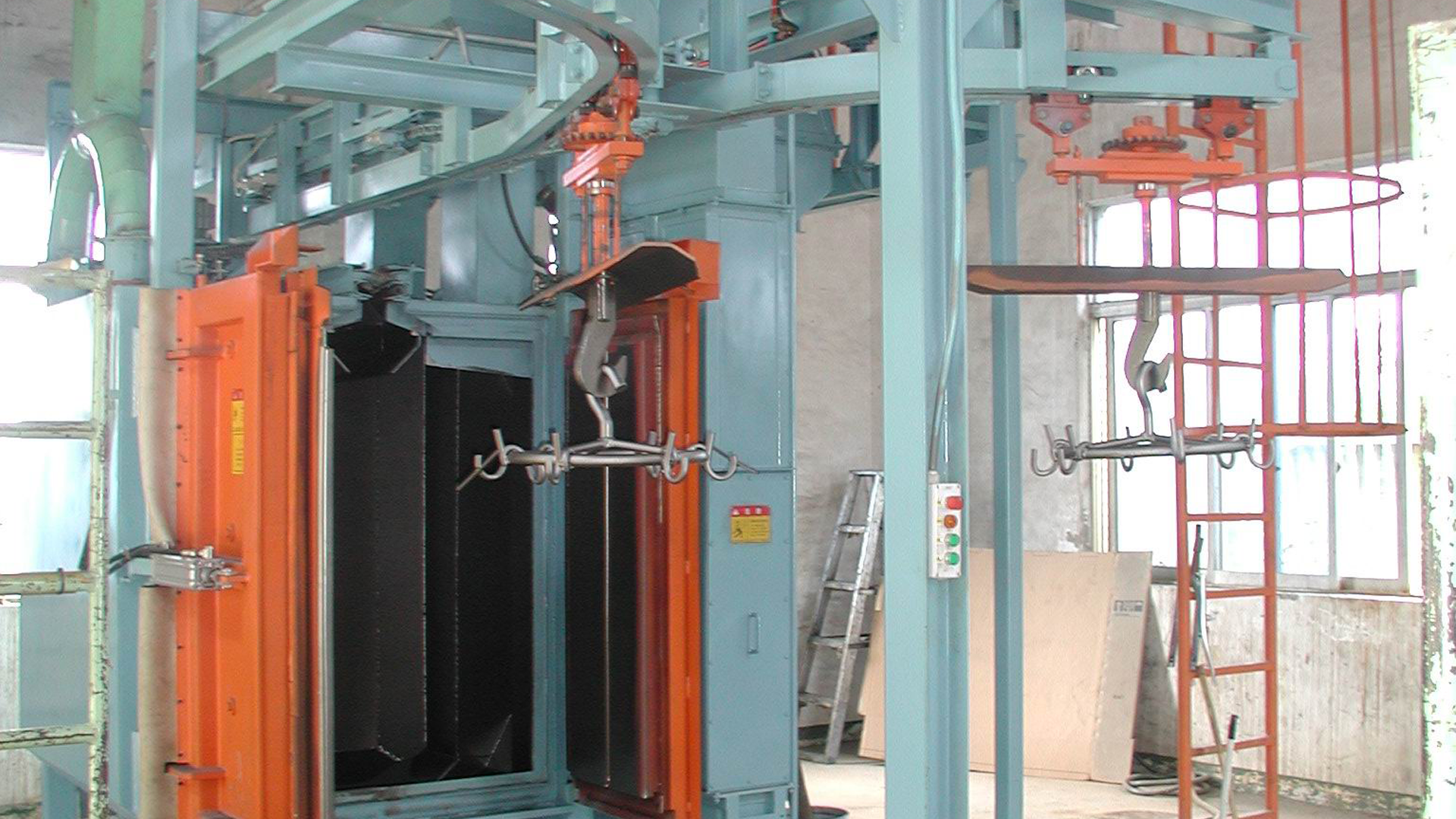
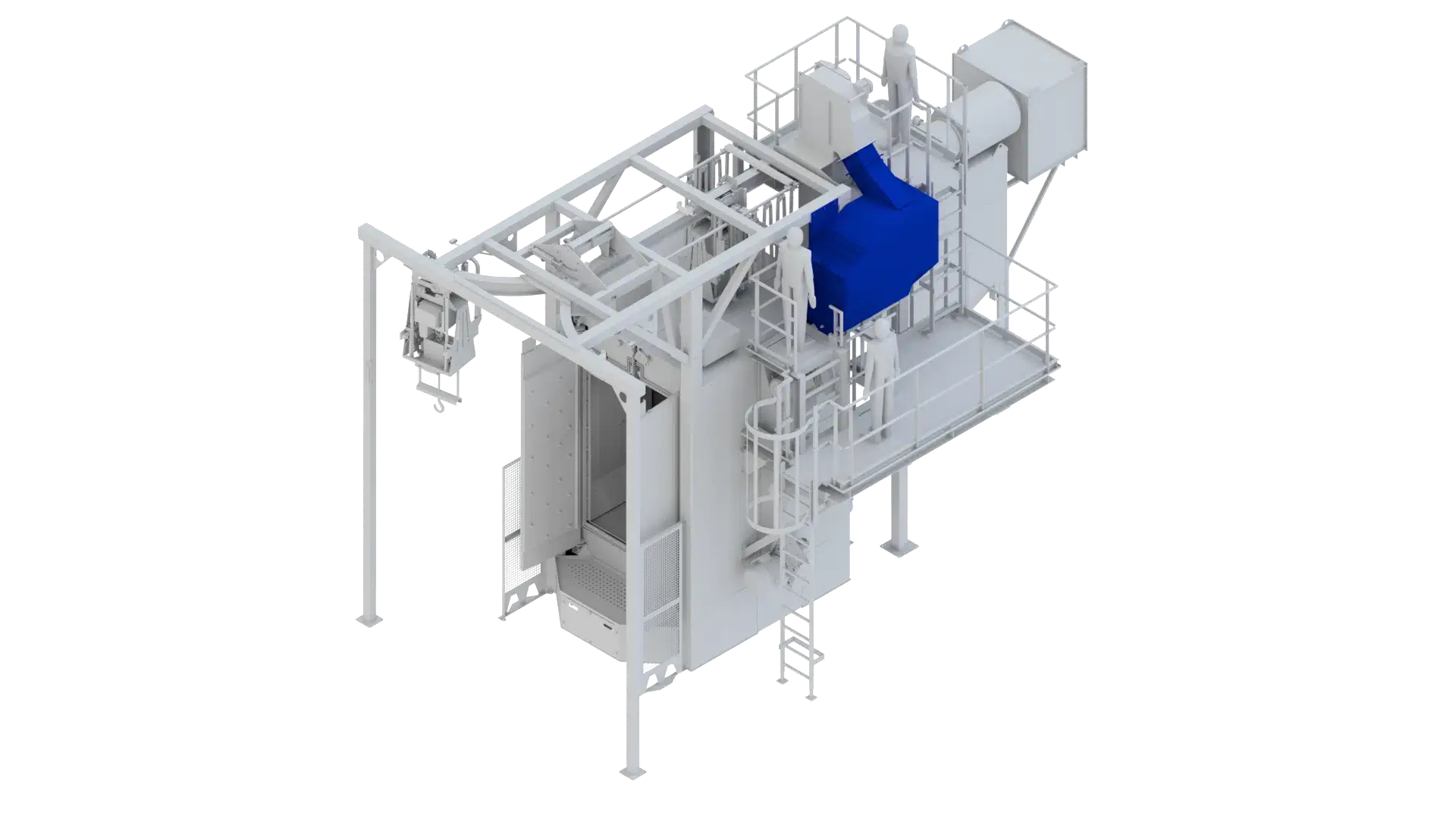
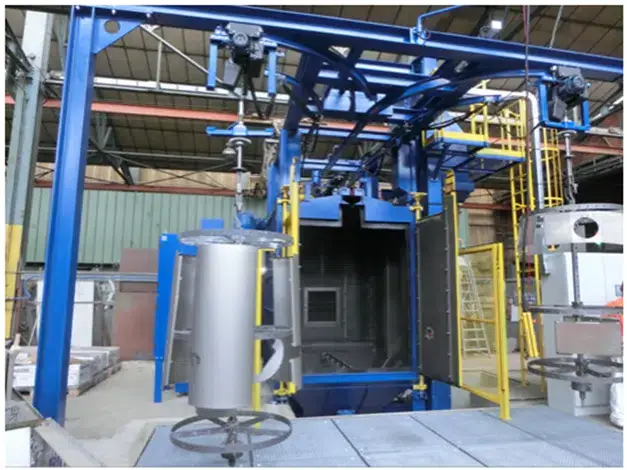
The spinner hanger machine is designed for shot blasting workpieces suspended from a rotating hook. During the blasting cycle, the hook rotates and traverses along the blast chamber to ensure uniform exposure of all surfaces.
Workpieces can be loaded individually or in groups using dedicated slings, provided they remain within the specified hook load capacity and dimensional limits. The system features two independently operated hooks on separate overhead rails, enabling continuous operation: while one hook is blasting inside the chamber, the other is automatically unloaded and reloaded outside.
Parts of a standard spinner hanger blasting machine
1) Machine Construction
The shot blast machine’s construction is made of high-quality structural steel and Mn 12/14% manganese steel, sheets and profiles, suitably shaped and welded.
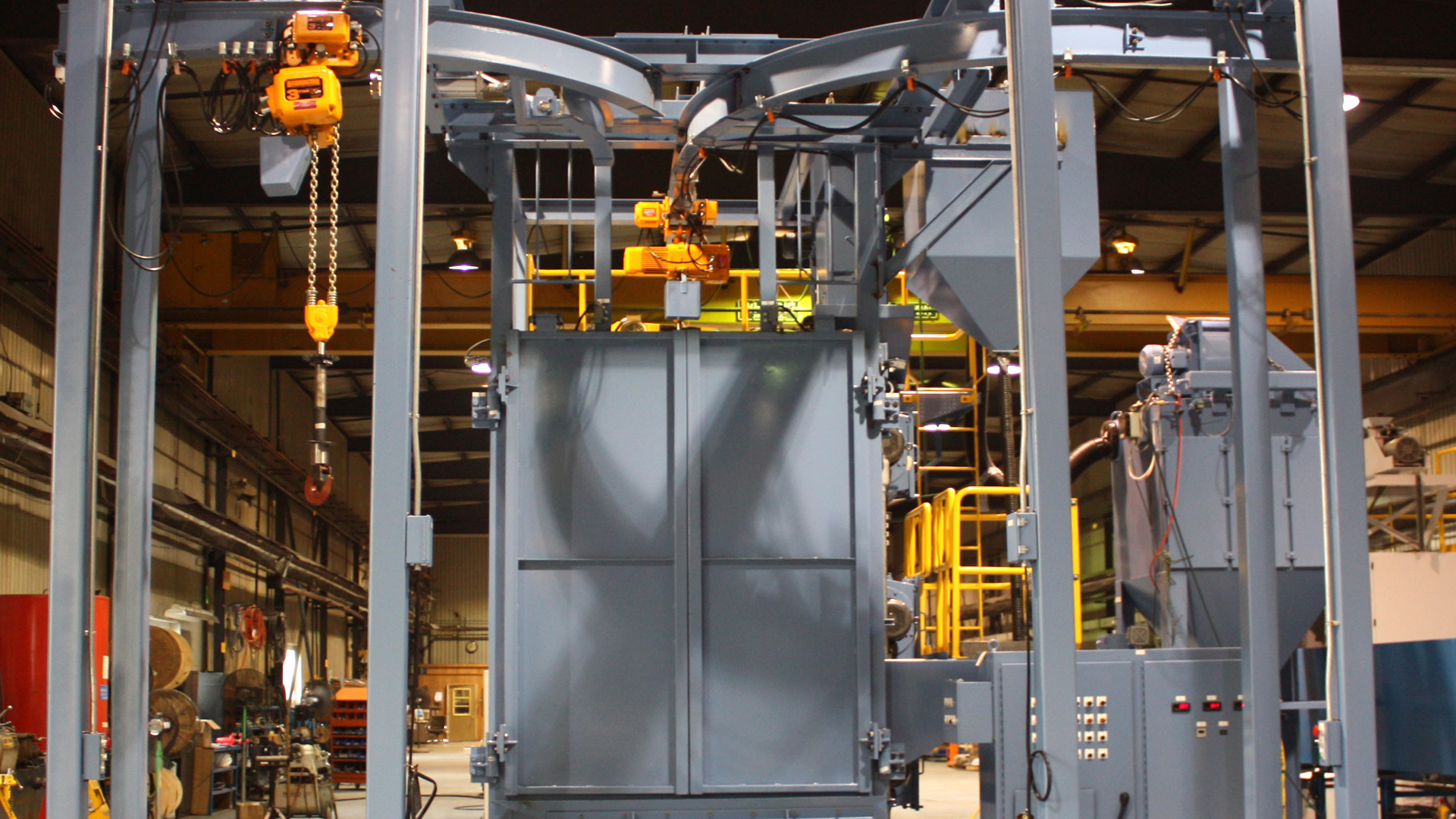
2) Automated doors
The machine is equipped with swing doors that open and close fully automatically using pneumatic actuators. The doors are equipped with safety sensors that activate the machine’s turbines. The door rim is equipped with a labyrinth seal and a rubber lining on the inside.
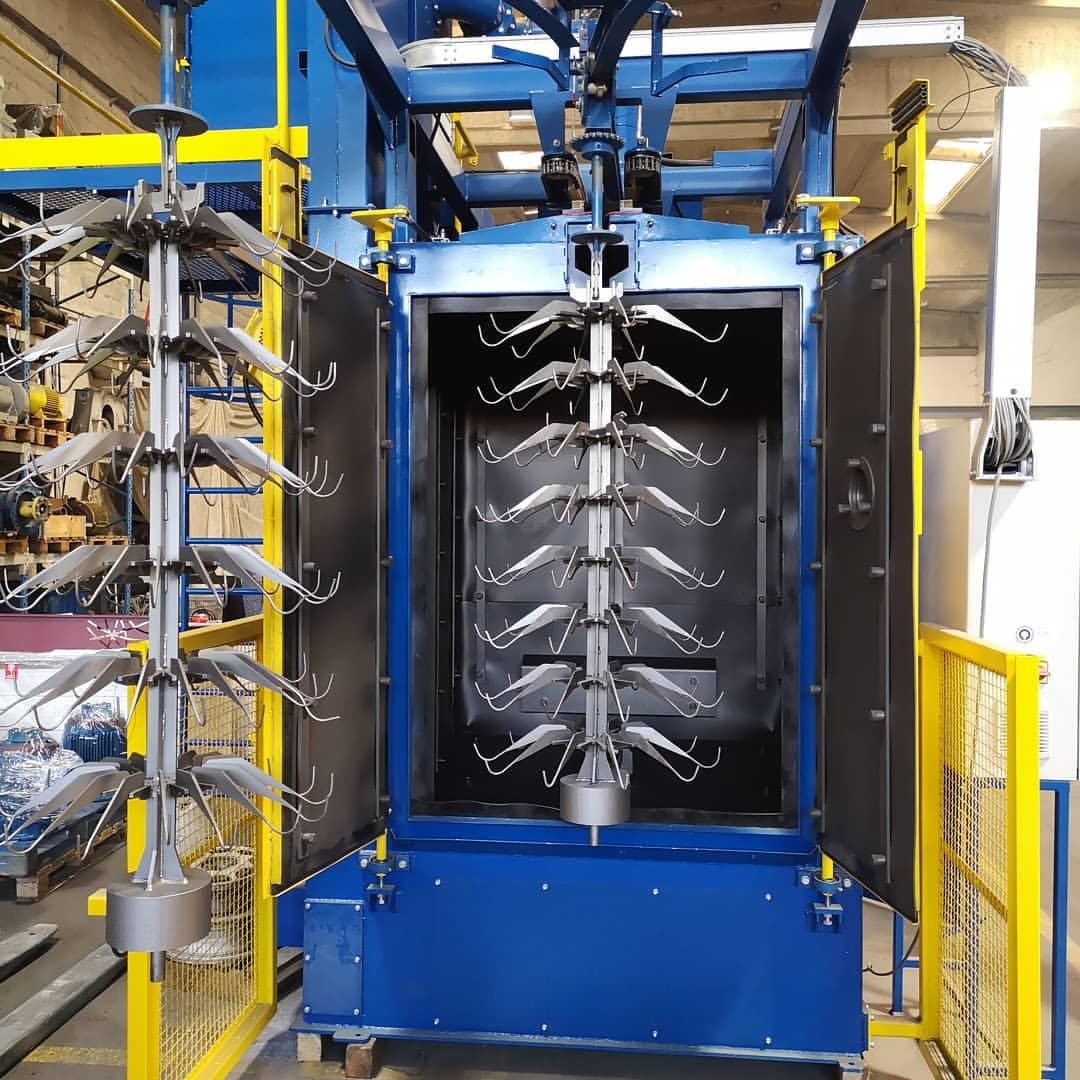
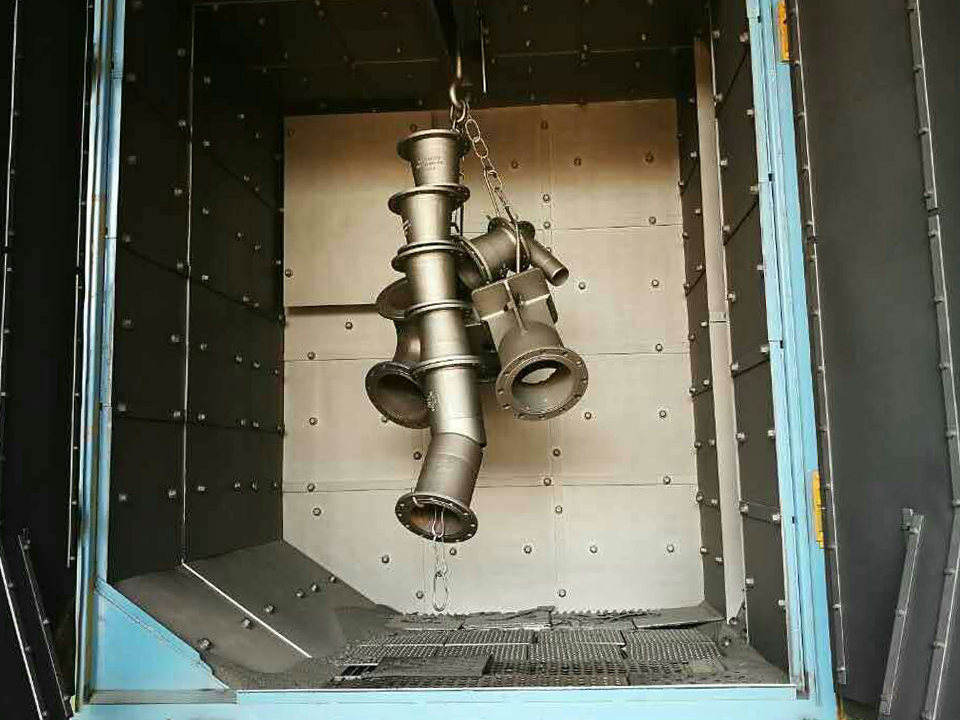
3) Working Chamber
The interior of the working chamber is lined with abrasion-resistant rubber and additional Mn 12/14% manganese plates in areas directly exposed to the abrasive discharged by the turbines.
4) Abrasive Recovery
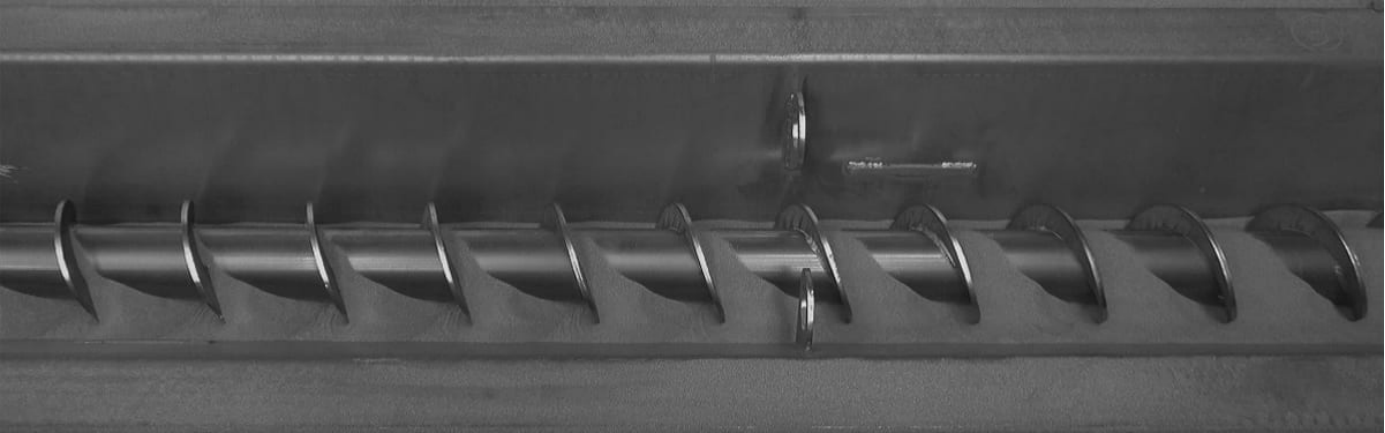
The abrasive is recovered by a screw conveyor located in a hopper beneath the working chamber. The shaft runs on self-aligning, double-sealed bearings. The screw is powered by an electric motor. The screw is shielded from direct exposure to abrasive material. Structure protection against the destructive effects of abrasive material:
• Additional manganese sheet metal on the ceiling and a robust hook cover made of manganese steel.
• Turbine mounting structure made of manganese steel.
• Screw cover made of manganese steel.
• High-quality, abrasion-resistant rubber inside the chamber and on the entrance door from a reputable supplier.
• Nylon brush prevents abrasive material from falling through the roof.
• Hook with additional cover.
Up to 70% higher blasting efficiency, 10 times longer life expectancy of the blades and 3x longer service life of the blast wheel is something that the GN blast Wheels offers. It is also extremely suitable for blasting with angular steel abrasive media which are usually detrimental to other types of blast wheels on the market.
Due to the deep knowledge developed during the R&D phase of GN Wheels, our experts tune the area of coverage by the wheel to get the maximum benefit in terms of using less number of wheels. Along with the other benefits listed, the GN wheel offers the quickest return on investment and a long life thereafter.
5)Paving Flooring
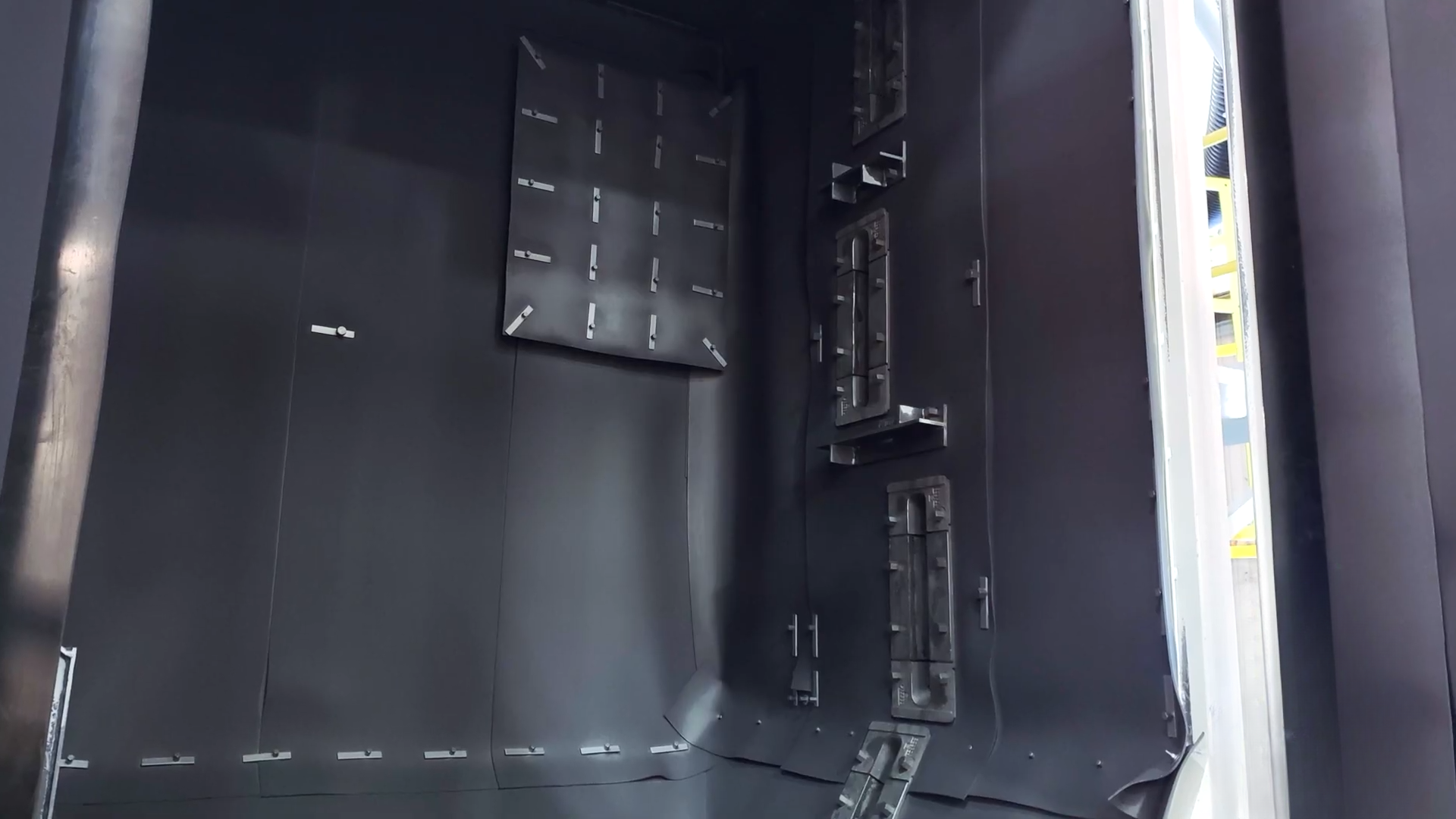
The floor is covered with wear-resistant support grids, partially made of manganese steel, which form the base for abrasion-resistant cast iron plates with holes. The flat floor also facilitates maintenance.
6) Bucket Conveyor
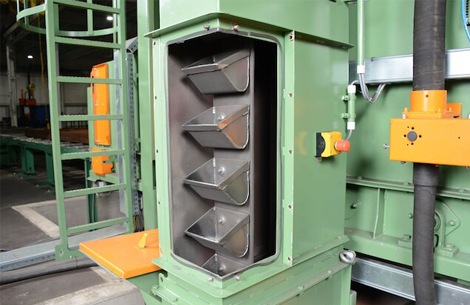
From the screw conveyor, the abrasive is transported to the bucket conveyor. It is made of bent sheet metal and has an inspection door. The bucket conveyor belt is mounted on two cast pulleys, the upper pulley being driven and also used to adjust the belt tension. The bearings are double-sealed. The buckets are bolted to the bucket conveyor belt. The buckets are stamped from a single piece of sheet metal, increasing their durability. The thick and durable conveyor belt is connected with a special connector, which allows for even load distribution. This bonding provides greater resistance to breakage.
The abrasive is transported by a bucket conveyor to the separator’s screw conveyor, which is equipped with a rotating screen to separate larger impurities from the abrasive. The abrasive is then moved to a pneumatic separator, which discharges the separated, crushed abrasive, dust, and impurities. The cleaned abrasive is collected in a hopper that feeds the turbines. click here.
7) Abrasive Separator
The abrasive is transported by a bucket conveyor to the separator’s screw conveyor, which is equipped with a rotating screen to separate larger impurities from the abrasive. The abrasive is then moved to a pneumatic separator, which discharges the separated, crushed abrasive, dust, and impurities. The cleaned abrasive is collected in a hopper that feeds the turbines.click here.
8) Abrasive Valves
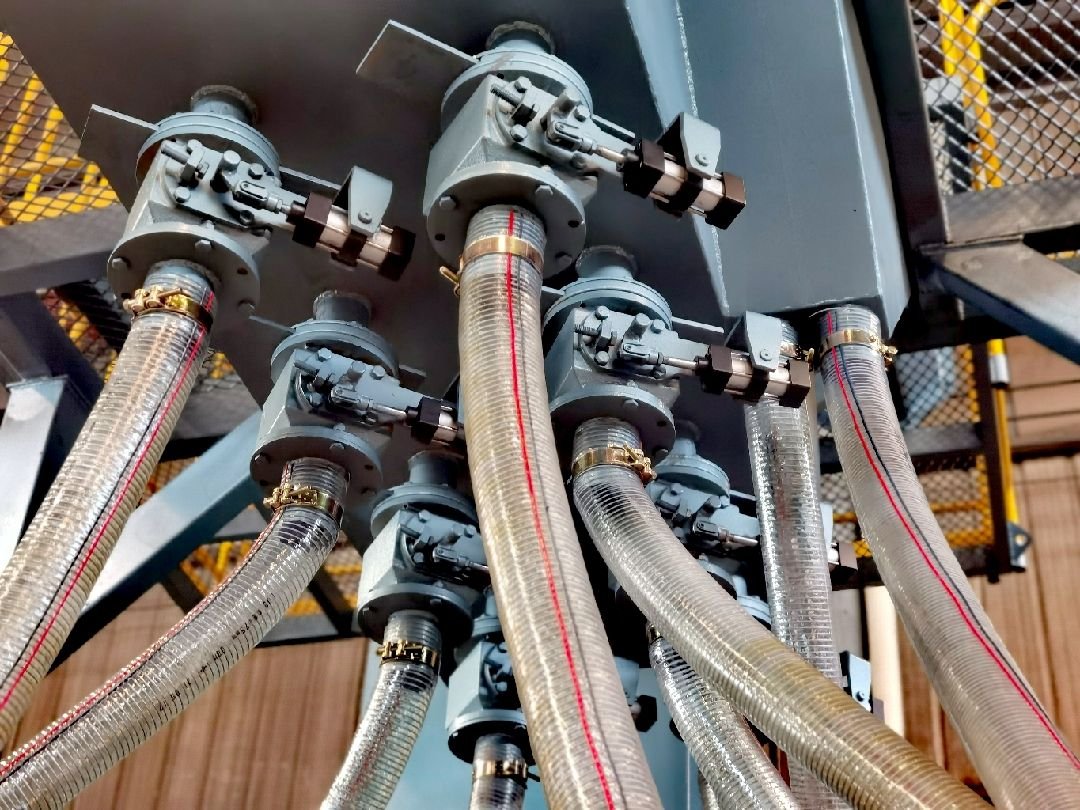
These valves are designed to meter the amount of abrasive feed to the turbines. Each turbine has one metering valve. They consist of a housing (casting) and a part actuated by a pneumatic actuator, which is partially closed and insulated to reduce noise levels and dust emissions. The valve opening is adjusted using a micrometer screw.
9)Blast wheel
Blast wheels with a head diameter of 350 mm. The turbine housing is made of special hardened steel. The internal parts of the turbines are protected by replaceable protective plates. Each turbine is equipped with 8 blades and an adjustable device for controlling the abrasive jet. The covers, blades, rotorsand other turbine components are made of wear-resistant material. The turbine
is designed to make component replacement quick and easy. The turbine shaft is mounted on dust-resistant bearings. Power is transferred directly.
More information about extraction system can be found here.
10)Overhead Conveyor
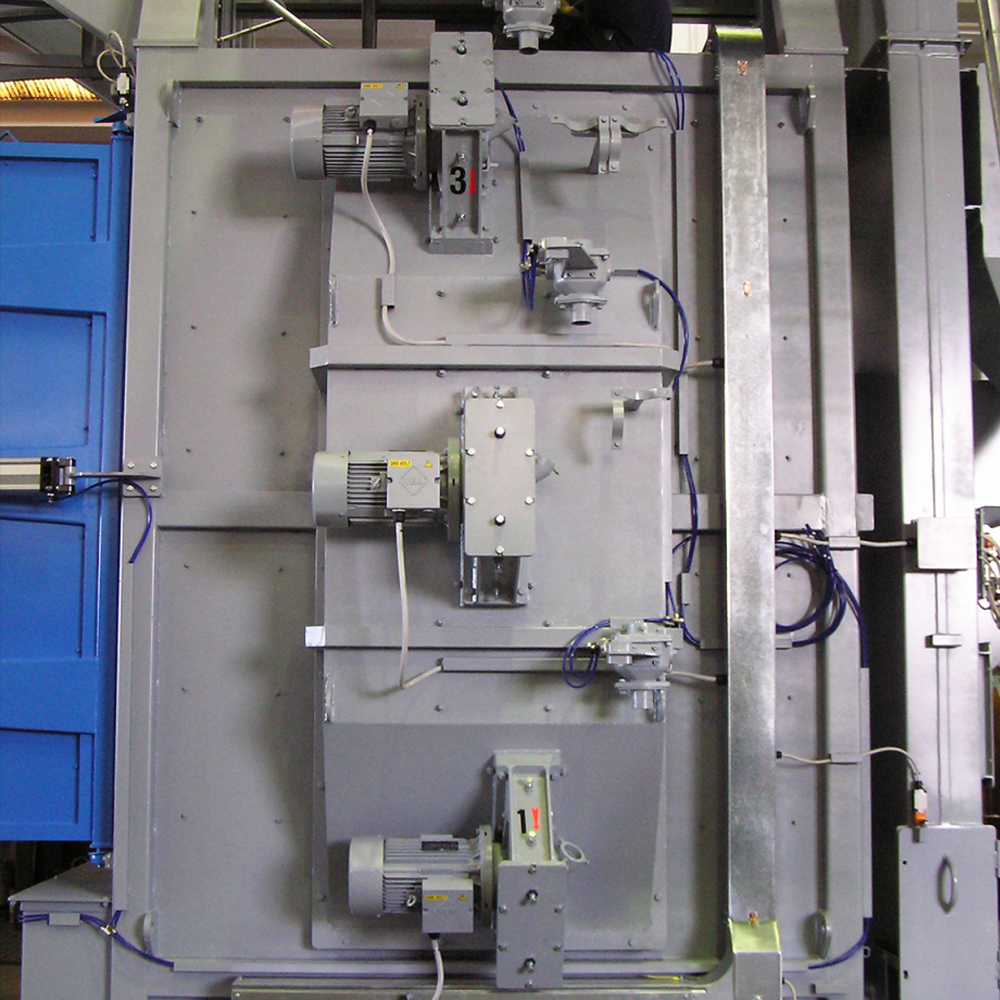
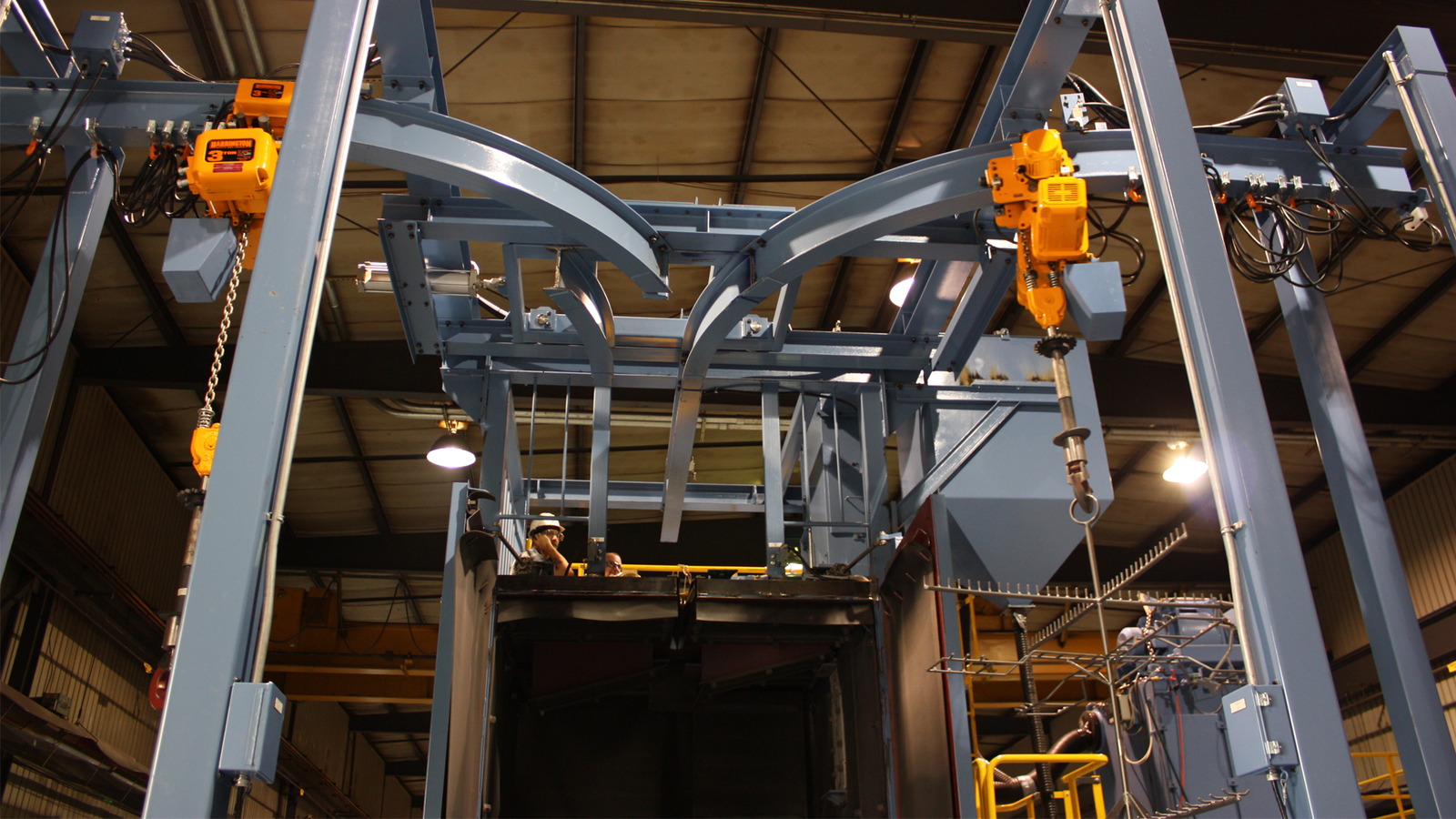
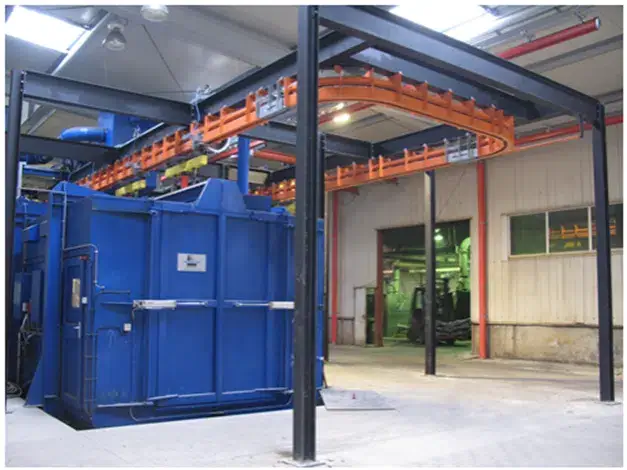
Based on two independent support profiles on which the trolleys move, a patented guide system uses a chain driven by a gear motor connected to an electric motor operating at two speeds and equipped with appropriate limit switches. The device allows for the insertion and removal of the hanger from the beginning to the very end of the turnout section (automatically) and movement during shot blasting inside the work cabin.
11)Dust seals
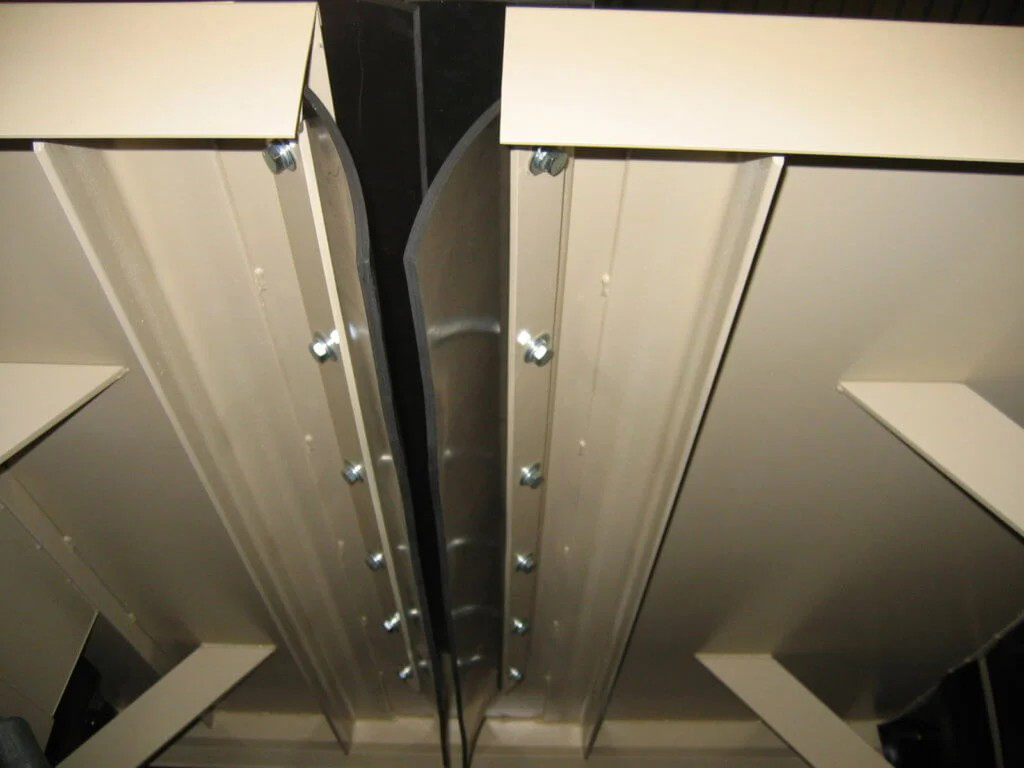
The top of the doors are provided with openings to enable transport of the products into and out of the blasting cabin. These openings have specially designed rubber flaps and sluices to ensure blockage against dust leakage.
12)Exhaust System
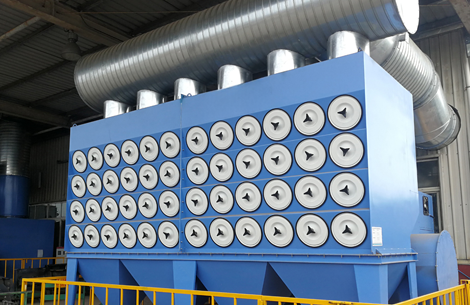
Constructed of sheet steel, forming a strong housing in which the filter cartridges are placed. Air contaminated with dust enters the filter, where it is decanted and sucked in by the filter cartridges. As it passes through the filter, the remaining dust is mechanically separated, and the cleaned air is blown out by a fan. The filter is equipped with an ECONOMIZER system that monitors the cartridge contamination level, ensuring that the cartridges are only shaken off when a sufficiently high level of contamination occurs. The cartridge filter is equipped with a set of nozzles that periodically blow out any remaining dust from the filter cartridges in the direction opposite to the suctioned contaminants, thus increasing the cartridges’ service life and technical efficiency. A pulse of compressed air flows through the filter cartridge in the direction opposite to the normal airflow. As a result, dust is captured, passes through the filter cartridge, and falls into the hopper. The sequence and intensity of the shaking off are adjusted using a special panel.
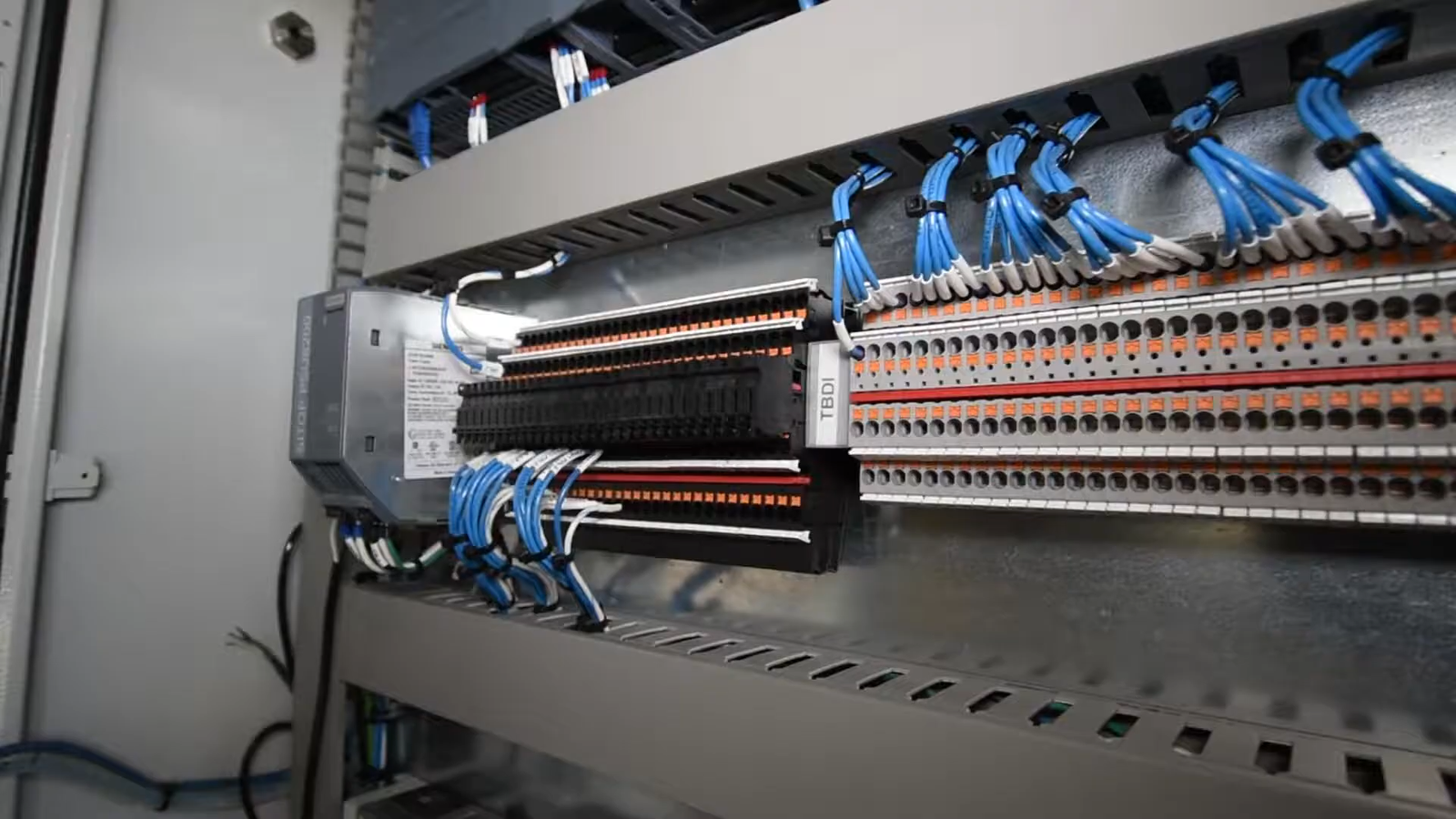
13)Control Cabinet
Including all necessary electrical equipment, buttons,
ammeters, an additional network with a distribution board, thermal relays,
and a central safety switch. All functions are
indicated by indicator lights located on the control panel.
Constructed of welded sheet metal, dust-proof. The control cabinet is manufactured
in accordance with IEC standards and EC guidelines. The mains voltage is 3-phase 400V – 50Hz (1-phase 115V or 230V). The electrical and pneumatic systems on the machine connect all these items to the control cabinet.
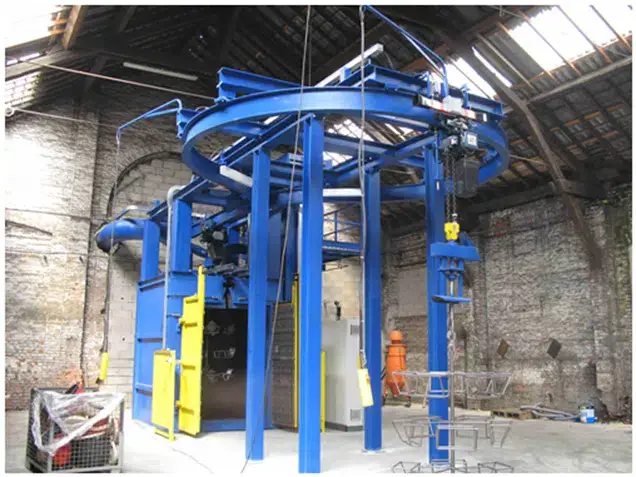
10)Overhead Conveyor
Based on two independent support profiles on which the trolleys move, a patented guide system uses a chain driven by a gear motor connected to an electric motor operating at two speeds and equipped with appropriate limit switches. The device allows for the insertion and removal of the hanger from the beginning to the very end of the turnout section (automatically) and movement during shot blasting inside the work cabin.
References
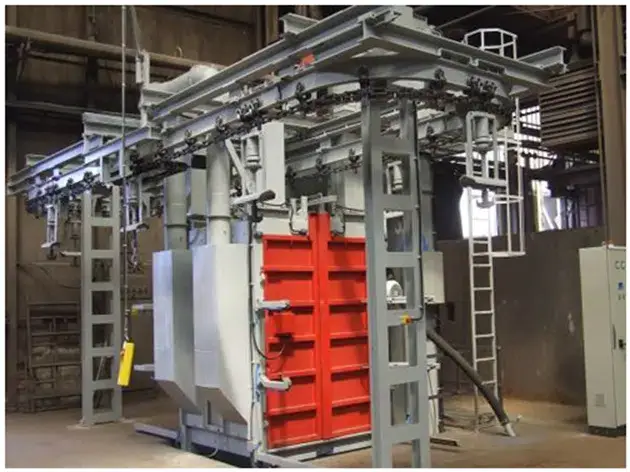
Over 40 years Disa has been providing bespoke solutions to clients worldwide. From valued individual clients to multinational companies, from single installations to complete inline solutions for large foundries and paint shops we offer a wide spectrum of solutions based on our clients needs. Feel free to browse through our reference sections for more details.